The one-line answer
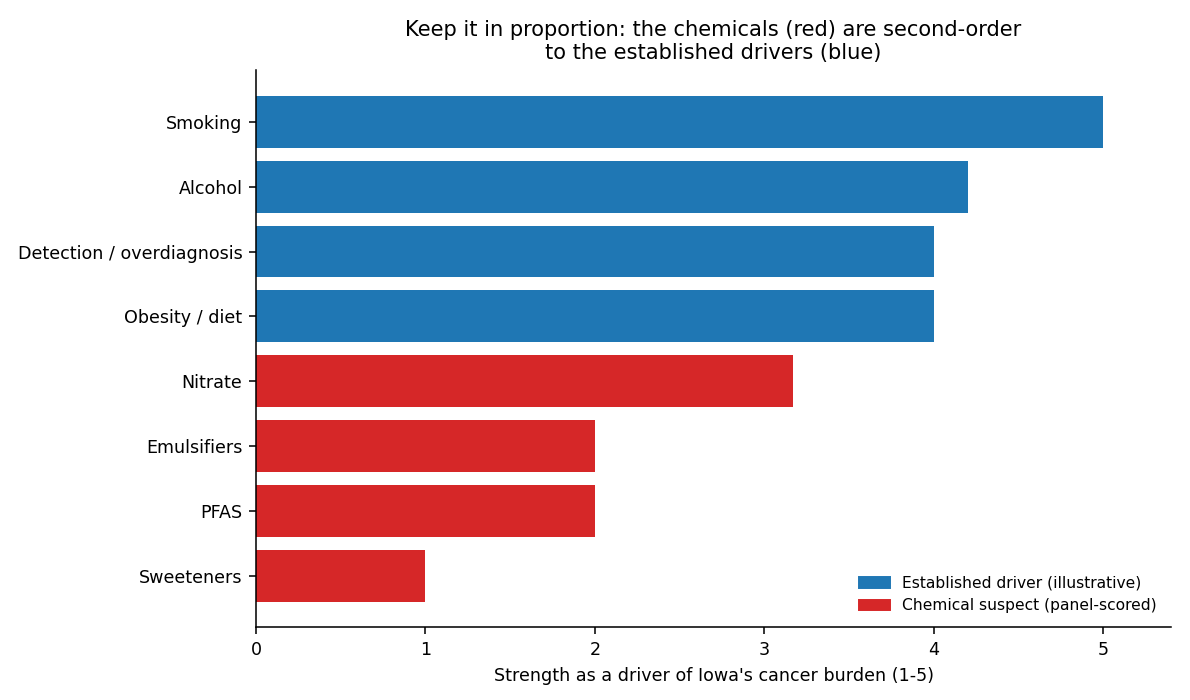
Of the four, only nitrate is worth real local attention (and even it is "plausibly a minor cause"). PFAS matters only near specific contaminated sources, emulsifiers have a great lab mechanism but thin human proof, and sweeteners are most likely a non-cause — possibly even protective. And none of them comes close to smoking, alcohol, obesity, or detection as a driver of Iowa's cancer burden.
Keep it in proportion (the most important figure here)
Before ranking the chemicals against each other, the honest move is to rank them against what actually drives cancer. Even the strongest chemical suspect is a second-order modifier next to the established causes.
The scorecard
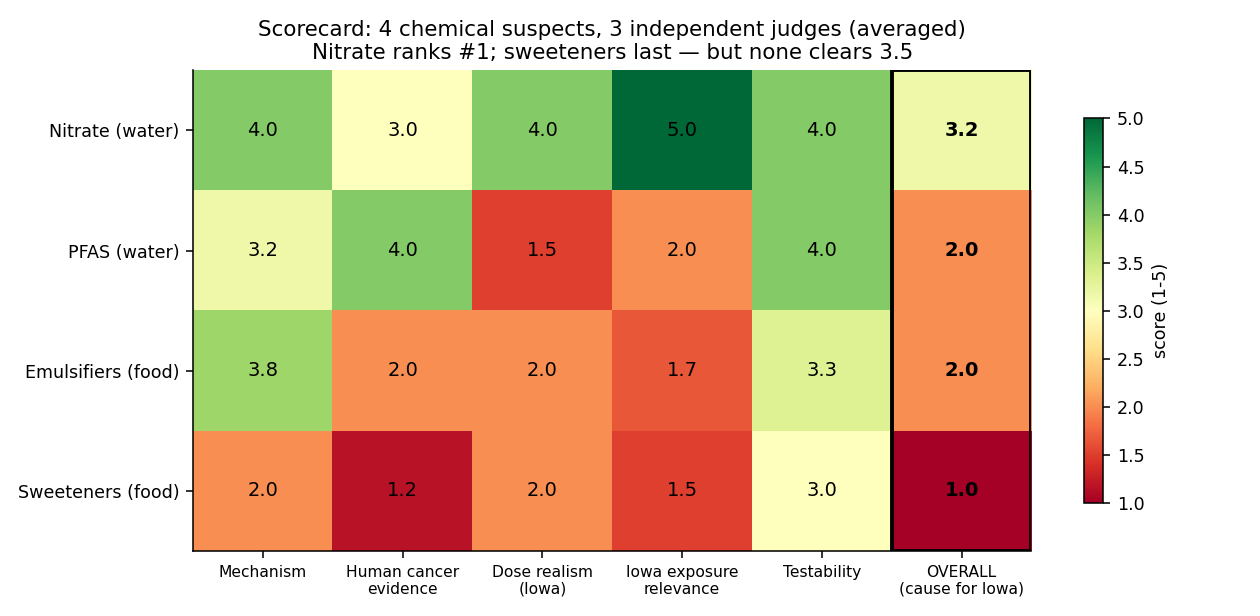
Three judges — a public-health epidemiologist, a mechanistic toxicologist, and a skeptical biostatistician — independently scored each agent 1–5 from the verified evidence. They produced the same #1 (nitrate) and same last place (sweeteners), disagreeing only on the PFAS-vs-emulsifiers middle.
| Rank | Agent | Overall (cause for Iowa) | Judge agreement |
|---|---|---|---|
| 1 | Nitrate (water) | 3.2 / 5 | Unanimous #1 |
| 2 (tie) | PFAS (water) | 2.0 / 5 | Contested middle |
| 2 (tie) | Emulsifiers (food) | 2.0 / 5 | Contested middle |
| 4 | Sweeteners (food) | 1.0 / 5 | Unanimous last |
The PFAS/emulsifiers tie is a real disagreement about what to weight: PFAS wins on hard human evidence (it's an established carcinogen), emulsifiers win on biological mechanism. Both score 2.0 overall.
One-line verdict per agent
Nitrate — plausibly a minor cause
The only agent where the hazard and Iowa's actual exposure overlap: median 5.7 mg/L sits in the "signal band" below a cancer-blind 1962 limit, with a real in-state cohort signal (bladder). Capped because the flagship colorectal meta is null and our county data is agriculture-confounded.
PFAS — real carcinogen, wrong dose
The strongest hazard pedigree (IARC Group 1) and best study design — but the kidney/testicular signals sit at occupational doses 7–16× Iowa background. Ambient Iowans are in the lowest-risk band; concern is narrow and point-source.
Emulsifiers — great mechanism, thin proof
The best experimental chain of the four (mucus thinning → encroachment → tumor promotion, germ-free causation) — but the human RCT was null on the actual mechanism, every emulsifier was colorectal-null in cohort, and there's no Iowa data. Live lead: the early-life exposure window.
Sweeteners — likely a non-cause
The human evidence points away from causation: meta null (colorectal decreased), Mendelian randomization null, the strongest molecule (sucralose) null, reverse causation unhandled. For early-onset CRC, swapping diet for sugar lowers risk. Possibly net protective.
The single honest takeaway
“Why do healthy young Iowans get cancer?”
Mostly the old, boring, hard things — tobacco's lingering legacy, alcohol, obesity, sun exposure, and the fact that we now detect more cancers than we used to — not a novel chemical in the water or food. For the genuinely puzzling part — cancer in young Iowans who never smoked — the leading lead is a birth-cohort shift driven by obesity, diet, and the gut microbiome, and that case remains unsolved. Of the four chemicals, nitrate is the only one worth real local attention (especially for the ~290,000 Iowans on unmonitored private wells). If you want to lower a young Iowan's cancer risk today, the evidence points at not smoking, drinking less, staying lean, and using sunscreen — far more than at any water filter or food label.
Honesty check — how this could overstate the chemicals
The unbiased ethos requires flagging how this very page could mislead:
- A tidy ranking implies relevance that isn't there. Naming a "winner" can suggest one of these chemicals is a meaningful cause. It ranks four weak-to-moderate candidates against each other; the winner is a minor cause and the rest are weaker.
- Nitrate's case leans on scattered, non-replicating signals (bladder here, gastric there) while its flagship colorectal meta is null. A skeptic could fairly score it below 3.
- “Established mechanism” does seductive work for emulsifiers. A beautiful mouse mechanism is easy to over-weight; it is not proof of human harm at human doses.
- The early-life / early-onset angle is a speculative wildcard, not a finding — a hypothesis worth testing, not evidence.
- Selection: these four were chosen as candidates; ranking them does not establish that the cause of Iowa's cancer lies among chemicals at all. The headline evidence says it mostly does not.
Panel scores: outputs/reopen/agent_panel.json · figures: analysis/p11_agent_scorecard.py
· per-agent briefs: NITRATE_IOWA.md, PFAS_IOWA.md, EMULSIFIERS.md,
SWEETENERS.md.